














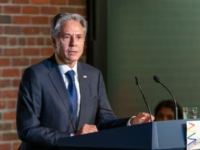





One hundred and seventeen former combatants have recently marked a pivotal achievement by completing a Disengagement, Rehabilitation, and Reintegration (DRR) programme, coinciding with the initiative’s expansion across the entire nation. For these individuals, receiving their certificates symbolizes not an endpoint but the beginning of a new chapter; for policymakers, the event represents a nuanced intersection of security strategy and social renewal.
As the DRR initiative evolves from localized pilots to a comprehensive national framework, the complexity of its implementation grows. This includes large-scale screening and counseling, vocational training aligned with actual economic opportunities, community readiness to welcome returnees, and robust systems to uphold justice while supporting victims. Beyond the celebrations and security measures lies the challenging, ongoing task of rebuilding trust.
This discussion delves into the significance of this milestone, contrasts the nationwide approach with previous efforts, and outlines the criteria by which progress or challenges will be assessed in the near future.reintegration as over a hundred former combatants graduate, highlighting insights on skills development, community healing, risk mitigation, and practical recommendations for livelihoods, mental health support, mentorship, and transparent oversight”>
Nationwide reintegration as over a hundred former combatants graduate, highlighting insights on skills development, community healing, risk mitigation, and practical recommendations for livelihoods, mental health support, mentorship, and transparent oversight
Celebrating a crucial advancement in peacebuilding initiatives, the graduation of 117 ex-combatants from the expanding Disarmament, Demobilization, and Reintegration (DRR) programme signals renewed optimism for communities across the country. This programme transcends conventional training by adopting a comprehensive strategy that enhances individual capabilities while promoting social harmony. Its foundation rests on several key pillars designed to guarantee lasting reintegration:
- Vocational and Entrepreneurial Training: Equipping participants with practical skills and business acumen tailored to current market needs, fostering sustainable income sources.
- Community Healing and Dialogue: Organizing facilitated conversations and trust-building exercises aimed at repairing social bonds and reducing prejudice.
- Risk Assessment and Emotional Support: Early detection of potential challenges combined with psychological care to strengthen mental resilience.
- Ongoing Mentorship and Counseling: Providing continuous personal development support and emotional guidance to aid long-term adjustment.
- Accountability through Transparent Oversight: Implementing thorough monitoring and evaluation systems to track progress and ensure program integrity.
These integrated components work synergistically to transform reintegration from a mere procedural step into a redefined journey toward lasting peace and economic empowerment. Scaling the programme nationwide significantly broadens its influence, laying the groundwork for enduring stability founded on inclusion and empowerment.




0 Comments